Resolution & print
Megapixel Counts and Image Quality Explained
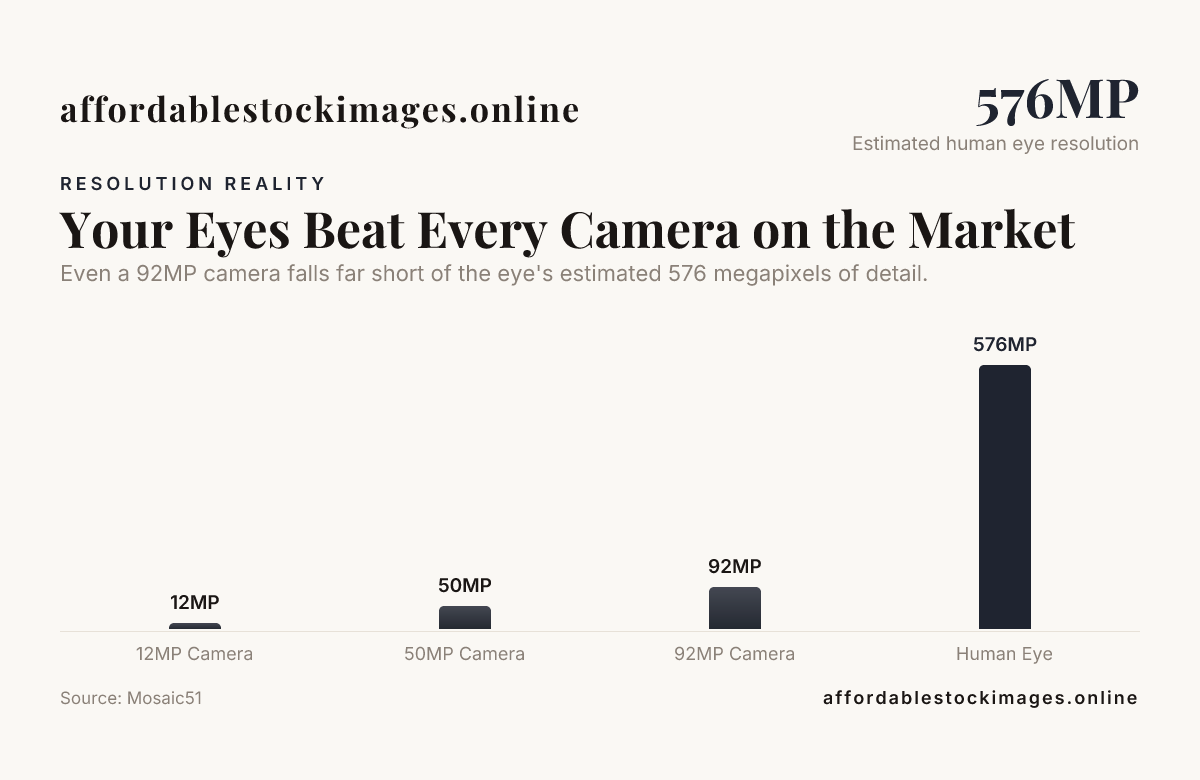
Megapixel Counts and Image Quality Explained in 2026, you still hear that more megapixels equals better photos. Did you know the human eye can distinguish roughly 576 megapixels of detail across its full field of view? That eye-level reference helps you gauge what MP counts actually buy you in real-world work.

Key Takeaways
- High megapixel counts enable more flexible cropping and print-scale potential, but image quality also depends on sensor size, lens quality, and noise performance.
- Common MP ranges in 2026 families sit around 2040 MP for many cameras, with premium options pushing higher into 50 MP and beyond for specialized workflows.
- 8K stock images often translate to around 33 megapixels in practical terms, which matters for large-format printing and high-resolution displays.
- JPEG versus RAW decisions impact post-processing latitude and color fidelity; stock images are typically delivered as JPEG for broad compatibility.
- Cropping flexibility grows with MP, but down-sampling and viewing distance can change perceived sharpness just as much as pixel count does.
- For print and display projects, understanding the target viewing distance helps you choose MP counts that align with your final output.
- For quick references, see our standard collection of 8K originals and the exact pixel dimensions used in typical 12 MP, 50 MP and 92 MP workflows.
In practice, megapixel counts are just one part of image quality. Our approach at the Blue Alloy Observatory is to help you map MP counts to actual project needs, not promises. We balance licensing clarity with technical detail so you can select stock images that fit your license scope and intended use.
Megapixel Counts and Image Quality Explained: The Basics
Megapixel is a single number that quantifies the total pixel count on a sensor. For example, 12 MP equals 12 million pixels, and it can be expressed as 12 MP 4000 3000 for a common aspect ratio. You can learn more about exact pixel dimensions and how to read camera specs by checking the spelling guides on our site.
In 2026 most cameras offer MP counts in the mainstream range of 2040 MP. Higher MP options exist, but the benefit depends on how you plan to view or print the image. If you are preparing 8K stock images, 8K JPGs are commonly delivered as 7680 4320 pixels, which translates to practical print or display considerations rather than a raw promise of crystal detail at every distance.

How Megapixel Counts Translate to Real World Quality
MP counts matter most when you intend to crop heavily, print large, or view from close distances. A 2040 MP camera often provides ample detail for most website- and screen-based work, while 50 MP and higher can preserve more detail through aggressive cropping or large-format printing. The nuance is not only about pixel counts; sensor quality and lens sharpness play major roles in perceived sharpness and color fidelity.
In practical terms, you may crop a high MP image and still retain more detail than a lower MP image shot at the same scene. A recent comparison shows that cropping by 50 percent can still leave you with higher resolution content than a lower MP camera like the Sony a6000, which runs at 24.3 MP. This highlights why MP should be considered alongside sensor size, noise performance, and optics.

Print Size and Viewing Distance: What 8K Stock Images Mean for You
Print size is not only about the pixel count; it is also about dpi or dots per inch. An 8K stock image measures 7680 4320 pixels, which means careful calculation for large prints. For banners or wall displays, you may reach practical limits at bigger sizes if you print at very high dpi, but at typical viewing distances the detail from 8K originals still shines.
JPEG versus RAW: What You Really Get with Stock Images
Most stock image downloads are delivered as JPEGs for broad compatibility and small file sizes. RAW files preserve more data but are not always practical for stock licensing or immediate publication. If your workflow demands maximum post-processing latitude, you may plan to work with RAW when you own the rights to the source files, but for ready-to-use stock, JPEG remains the standard baseline.
Megapixel Counts in 2026: Practical Guidelines for Projects
When selecting megapixel counts for a project, align MP with print size, viewing distance, and required post-processing. For website imagery, 2040 MP often provides ample detail with smooth down-sampling for web delivery. For large prints or high-end advertising, 50 MP and above can guarantee room to crop without losing sharpness.
We also factor in licensing and delivery formats. Our stock images are 8K originals delivered as 8K JPG with a single-user license that covers unlimited projects for that buyer and never expires. For teams that need flexible licensing, the standard collection is a reliable base, offering 8K originals with straightforward pricing.
Choosing Megapixel Counts for 2026 Projects
Choose MP counts with project goals in mind. For editorial or architectural work that requires precise measurements or large-format displays, higher MP can help with cropping latitude. For social content, a balanced approach around 2040 MP often delivers clean images with efficient workflows.
We recommend testing across your target devices and viewing distances. If you publish across multiple channels, plan for a mix of high resolution images and optimized web-ready files. This approach keeps your options open without overpaying for unused MP capacity.
Conclusion: Read the Details, Then Decide on MP Counts
Megapixel Counts and Image Quality Explained in 2026 boils down to choosing the right balance. You want enough detail for your final output, but you also need to consider post-processing needs, licensing, and delivery formats. Use MP as a flexible tool, not a sole predictor of overall image quality. Our Blue Alloy Observatory guidance helps you navigate these choices with clarity and concrete product examples.

Frequently Asked Questions
What megapixel should I look for in a camera in 2026?
Megapixel counts depend on your use case. For most online content and standard prints, 2040 MP provides ample detail and flexibility. For large prints or crops, consider 50 MP or higher while evaluating sensor quality and optics.
Is more megapixels always better for image quality?
No. Image quality depends on many factors beyond MP, including sensor size, lens quality, dynamic range, and noise performance. Higher MP can improve cropping, but it does not guarantee superior overall image fidelity in every scenario.
How many MP do I need for large prints?
For large prints, higher MP helps preserve detail when you crop or view up close. Start with 4050 MP for very large prints and consider down sampling for web-ready versions to keep file sizes manageable.
What is the practical difference between 20 MP and 50 MP?
The difference is most noticeable when you crop heavily or plan large prints. 50 MP offers more latitude for cropping without losing detail, while 20 MP is typically sufficient for standard prints and online use.
Do stock images with 8K resolution mean better quality?
Not automatically. 8K refers to the dimension of the image data. The perceived quality also hinges on compression, color depth, and how the image is processed for delivery. Our standard 8K originals are designed for flexible use with clear licensing and format options.
How does viewing distance affect megapixel needs?
Closer viewing distances reveal more detail, so higher MP can improve perceived sharpness. At typical viewing distances for prints and displays, moderate MP counts often deliver the best balance of detail and file efficiency.